A Small Thing We Learned This Week
This is a rare issue — only a handful of users have reported it — but it's worth writing up because the cause is surprising and the fix is now in place.
Two weeks ago, a user said a sharable.link wouldn't open on their laptop. We looked into it. The link worked on every device and network we tried. Nothing in the logs. The next day they said it was working again. Looked like a one-off.
Then last week, on a call with a client, we hit the same wall. The link opened on our laptop, not on theirs.
So we dug deeper.
The Real Problem: TLD Reputation
It turns out enterprise DNS sometimes blocks .link domains wholesale. The TLD is cheap, which makes it popular for phishing, which makes some IT teams block it across the board. Low signal-to-noise — easier to ban every .link than to triage them one by one.
This is not a new pattern. There's a funny Spiceworks thread from 2014 where sysadmins were already calling .link domains "spammy" and openly discussing blocking the entire TLD at the network level. Over a decade later, those filters are still in place — and new ones keep getting added.
The tricky part: the blocks are usually temporary. A few hours, sometimes a few days. They often clear when the user switches networks. And as far as we can tell, there's no way to detect them from our side.
That's why the first report looked like a fluke. By the time we checked, the link was working again. Rare enough to stay invisible until it bites you on a client call.
To be clear: this is not something the average user will ever encounter. Most networks let .link through fine, and the vast majority of sharable.link URLs open without issue. But for the small slice of users behind aggressive enterprise filters, it's a real problem — and worth solving.
Why .link Was Picked in the First Place
The name was perfect. sharable.link says exactly what the product does. There's no copy to write — the URL is the pitch.
Turns out it was perfect for spammers too. Same reasoning, opposite intent.
The lesson, in retrospect: a domain isn't just a name. It's a reputation signal that travels with every link you ever publish. Choosing one based purely on memorability is fine for an internal tool. For something users send to clients, the TLD's reputation matters as much as the name.
Where the Blocks Show Up
From the few cases we've seen so far:
- Corporate networks with deep packet inspection or DNS filtering (Zscaler, Netskope, Cisco Umbrella, etc.)
- Some VPNs that bundle threat-intel feeds
- Specific countries' ISPs with strict reputation filters
- Antivirus suites that include URL reputation scanning
The blocks are inconsistent. Two laptops on the same network can have different results based on which security agent is installed. A single user can hit the block one day and not the next.
We're also not the only service running into this. Linkly, another link-sharing tool, has a public support page on links being blocked by spam filters — same root cause, same advice (use a domain with stronger TLD reputation). It's a quiet, persistent issue across the whole short-link ecosystem.
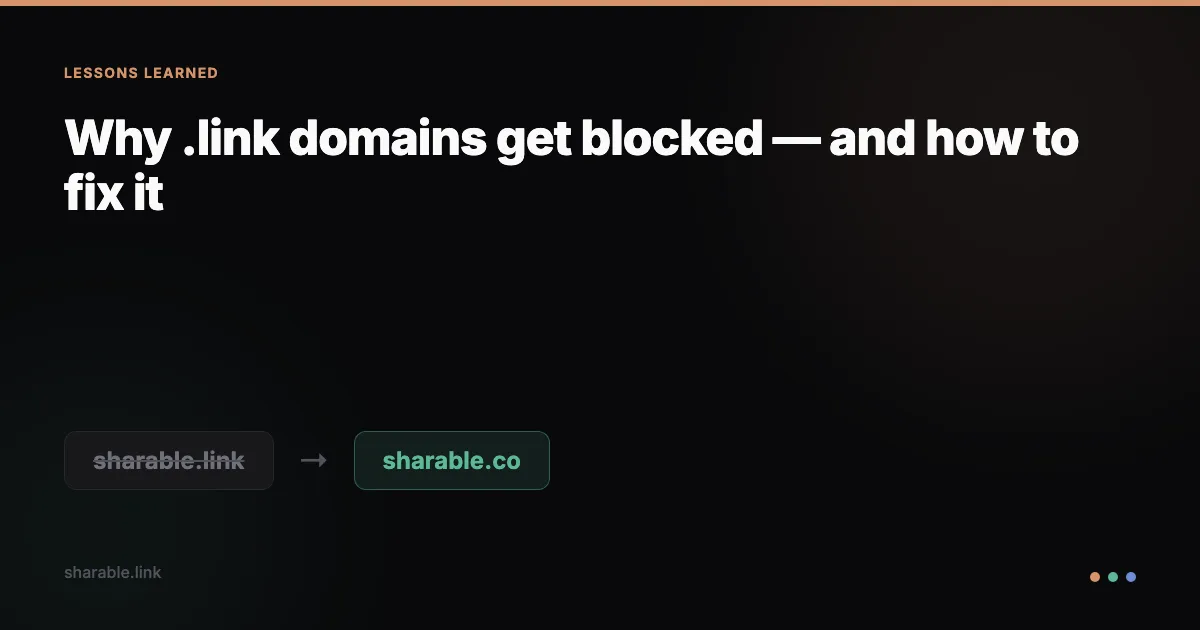
The Fix: sharable.co as an Alias
We bought sharable.co and configured it as an alias for the same app. Same backend, same database, same slugs.
That means:
- Every link ever shared on
sharable.link/abc123also works onsharable.co/abc123 - No data migration needed — the slug lookup is identical
- New links can be shared on either domain
If you shared a sharable.link URL with someone and it didn't open, just send them the same URL with sharable.co instead. Same product, same content, different door.
.co has stronger TLD reputation. It's older, more expensive (~$30/yr vs $5 for .link), and most enterprise filters don't blanket-block it. It's the same TLD Twitter uses for t.co, which is one of the most-clicked domains in the world.
What's Coming Next
The alias is the quick fix. We're also considering making sharable.co the primary domain and having sharable.link 301-redirect to it for everything — but that's a decision still being weighed against the cost of a brand transition. For now, both domains work and either one will resolve correctly.
If you've shared old sharable.link URLs in emails, decks, or messages, they'll keep working. Either domain resolves to the same content for the same slug.
The Takeaway
If you're building anything with public links — a URL shortener, a sharing tool, anything where users send links to other users — the TLD matters more than you think. Cheaper TLDs get abused, get blocklisted, and the fallout lands on legitimate users without warning.
The biggest lesson: check TLD reputation before buying. Cloudflare, Spamhaus, and a few security vendors publish data on which TLDs trigger filters most often. A 30-minute search would have caught this before launch.
Old links keep working. New links are stronger. Onwards.